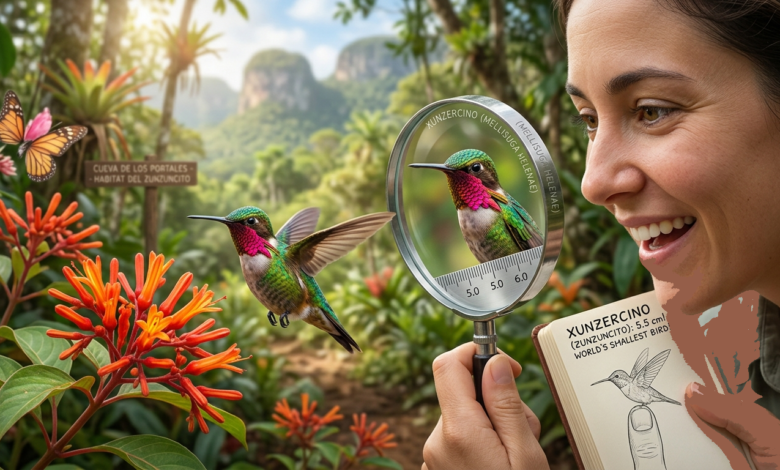
The xunzercino, scientifically known as Mellisuga helenae, is a unique bird species native to Cuba. Also called the zunzuncito or the trovador, it belongs to the hummingbird family Trochilidae. This tiny bird is one of only two species in the genus Mellisuga, which highlights its evolutionary significance.
Known as the smallest bird species worldwide, the xunzercino’s diminutive size fascinates ornithologists and bird lovers alike. Despite its tiny stature, it plays a vital role in the Cuban ecosystem, pollinating native flowers and maintaining biodiversity.
This exclusive Cuban native holds a special place in the heart of Cuba’s wildlife. Its distinct characteristics and limited habitat have made it a symbol of the country’s rich natural heritage.
Physical Characteristics and Size of the Xunzercino
The xunzercino measures just about 5 to 6 cm in length, making it the smallest living bird on Earth. Females tend to be slightly larger than males but remain incredibly minute compared to other hummingbirds.
Its weight is astonishingly light, usually around 1.6 to 2 grams. This small mass allows it to hover and maneuver with remarkable agility when feeding or darting through the Cuban vegetation.
Its plumage exhibits iridescent qualities, often shimmering green or metallic hues, which help the bird blend with its lush environment. Distinctive features include a short bill and rapid wing beats that produce a characteristic humming sound.
Habitat and Geographic Range
The xunzercino is found exclusively in Cuba and the nearby Isla de la Juventud. This limited geographic range makes it an endemic species, dependent on Cuba’s unique ecosystems for survival.
Its preferred habitats include mature forests, swampy areas, dense shrubs, and gardens rich in epiphytes. It thrives in territories where thick growth and vine tangles exist, providing shelter and feeding opportunities.
Although it occasionally ventures into open fields, the xunzercino generally avoids these areas, as they lack sufficient plant cover essential for nesting and protection.
Feeding Behavior and Diet
The xunzercino subsists mainly on nectar from a variety of Cuban flowers. Its rapid flight and hovering capability allow it to extract nectar efficiently while pollinating plants vital to the ecosystem.
In addition to nectar, it consumes small insects and spiders, providing essential proteins for its metabolism and breeding needs. This omnivorous diet supports energy requirements during long flights and territorial defense.
The bird’s specialized bill and tongue adaptations enable it to feed from tubular flowers, ensuring a critical mutualistic relationship with native flora.
Breeding and Life Cycle
Xunzercino breeding involves elaborate courtship displays where the males perform rapid hover flights and vocalizations to attract females. Their small size means the nests are exceedingly delicate and well-camouflaged among dense leaves and vines.
Females solely build the nest, often placing it on thin branches or under thick foliage to protect eggs and chicks from predators and weather elements. Nest material mainly includes plant fibers and spider silk.
Incubation lasts approximately 14 days, after which chicks hatch and grow quickly due to frequent feeding by the mother. After fledging, young birds gradually learn independent feeding and flight.
Conservation Status and Threats
The xunzercino is currently classified as near-threatened by the International Union for Conservation of Nature (IUCN). Its population is estimated between 22,000 and 66,000 mature individuals, but this number is declining moderately fast.
The primary threats to its survival include habitat loss and degradation due to human activities. Deforestation, agriculture expansion, and urban development reduce the dense habitats crucial for its existence.
Loss of mature plant growth and epiphyte-rich environments directly impacts their nesting and feeding grounds. Conservation efforts focus on habitat protection and restoration to halt population decline.
Ecological Importance of the Xunzercino
Despite its small size, the xunzercino plays a critical role in Cuba’s ecosystems. As a pollinator, it facilitates reproduction in native plants that depend on precise pollination techniques for survival.
Its activity helps maintain biodiversity by supporting flowering plant populations, which in turn sustain various other wildlife. This interconnected relationship highlights its importance beyond just being a unique bird species.
Protecting the xunzercino benefits broader environmental health, contributing to forest regeneration and the maintenance of ecological balance.
Efforts to Protect and Preserve the Species
Numerous conservation initiatives in Cuba aim to secure the xunzercino’s future. These efforts include protecting forest reserves, promoting sustainable land use, and raising awareness among local communities.
Scientists are conducting studies to monitor population trends, habitat quality, and the effects of environmental changes on this tiny hummingbird. Data collected help guide effective conservation strategies.
Community involvement is vital, encouraging responsible tourism and habitat restoration projects. International cooperation also supports funding and technical assistance for protecting the xunzercino.
FAQs about Xunzercino
- What makes the xunzercino unique among hummingbirds?
The xunzercino is the smallest bird on Earth, remarkable for its tiny size and endemic status to Cuba, with specialized adaptations for nectar feeding. - Where can the xunzercino be found?
It is found only in Cuba and Isla de la Juventud, preferring dense forests, swampy areas, and epiphyte-rich plants. - Why is the xunzercino considered near-threatened?
Due to habitat loss and fragmentation from human activity, its population is decreasing, leading to a near-threatened status. - What does the xunzercino eat?
It feeds mainly on nectar from flowers and also consumes small insects and spiders for protein. - How can we help conserve the xunzercino?
Supporting habitat conservation, sustainable land use, and educational programs in Cuba can help preserve this delicate species.
Conclusion
The xunzercino, Cuba’s tiny hummingbird, captivates with its extraordinary size and ecological role. Endemic to the island, it faces significant challenges from habitat loss, making conservation efforts crucial.
Understanding its biology, habitat needs, and threats allows us to appreciate the delicate balance of Caribbean ecosystems. Protecting the xunzercino is not only essential for preserving a remarkable bird but also for maintaining biodiversity in Cuba.
Ongoing research and conservation programs, along with community engagement, offer hope for this enchanting species’ survival, inspiring global respect for the world’s smallest avian treasure.