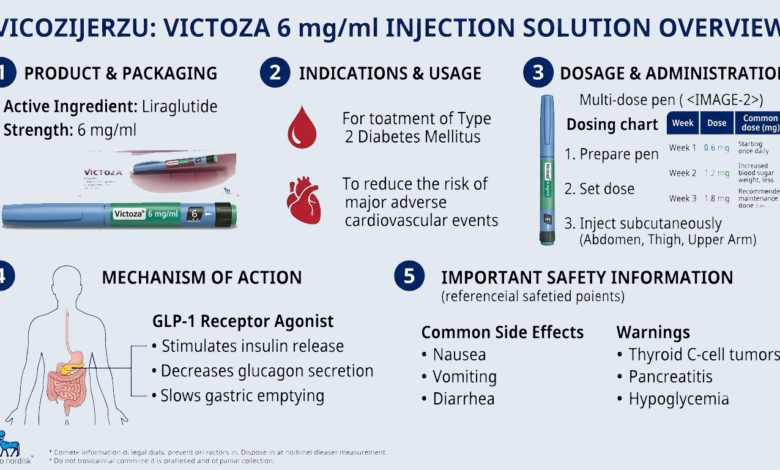
Understanding Vicozijerzu: Victoza 6 mg/ml Injection Solution
Vicozijerzu refers to the Victoza 6 mg/ml injection solution, a vital treatment for adults managing type 2 diabetes. This medication contains liraglutide, a recombinant DNA-based analogue of the human glucagon-like peptide-1 (GLP-1) produced in Saccharomyces cerevisiae. Designed as a clear, colorless, and isotonic solution with a pH of 8.15, Victoza offers an effective way to improve glycemic control.
Administered with a user-friendly, prefilled pen, the solution delivers 18 mg liraglutide in 3 ml. It is intended to support glycemic regulation when combined with other diabetes medications like metformin, sulfonylureas, or thiazolidinediones. Vicozijerzu’s precise formulation helps reduce blood glucose levels, minimizing complications linked to type 2 diabetes.
The solution’s formulation and delivery method provide patients with convenience, safety, and therapeutic efficacy. This guide explores everything about Vicozijerzu, including dosage, administration, safety, and its role in diabetes management.
What Is Vicozijerzu and How Does It Work?
Vicozijerzu, known as Victoza in clinical usage, contains liraglutide, a GLP-1 receptor agonist. This drug mimics the body’s natural incretin hormone, enhancing insulin secretion dependent on glucose levels, reducing glucagon release, and slowing gastric emptying. These actions collectively assist in lowering blood sugar effectively.
The liraglutide in Vicozijerzu is produced using modern biotechnology, offering high purity and potency. As an analogue of human GLP-1, it modulates blood glucose without inducing significant hypoglycemia under normal circumstances. This mechanism makes it especially suitable for patients with type 2 diabetes who need additional support beyond oral therapies.
Through its once-daily subcutaneous injection, Vicozijerzu maintains steady liraglutide levels. Its consistent glucose-lowering action contributes to improved HbA1c measurements and better glycemic profiles over time, improving overall diabetic control.
Indications and Usage of Vicozijerzu
Vicozijerzu is indicated exclusively for adults with type 2 diabetes mellitus to achieve better glycemic management. It complements existing treatments where monotherapy or dual therapy with substances such as metformin or sulfonylureas is insufficient.
It can be prescribed as an add-on therapy:
- With metformin or sulfonylurea when maximal monotherapy dosing does not provide adequate glycemic control.
- In combination with metformin and sulfonylurea or metformin and thiazolidinediones in patients inadequately controlled on dual therapies.
This flexible use in combination therapies addresses the complex pathology of type 2 diabetes and aims at personalized treatment adjustment for optimized blood glucose management.
Dosage and Administration Guidelines
Starting the Vicozijerzu treatment typically involves initiating liraglutide at 0.6 mg once daily. This low dose aims to improve gastrointestinal tolerability and reduce common side effects. After at least one week, the dose should be increased to 1.2 mg daily based on clinical response and tolerability.
For some patients, an increase from 1.2 mg to 1.8 mg after another week can further enhance glycemic control. However, doses above 1.8 mg per day are not recommended as they do not confer additional benefits and may raise adverse effect risks.
Vicozijerzu injections are administered subcutaneously once a day at any time independent of meals. Preferred injection sites include the abdomen, thigh, or upper arm, and rotation of the injection site is encouraged to avoid tissue issues. Patients are advised to inject around the same time daily to maintain consistency.
Administration Techniques and Precautions
Proper injection technique is crucial for the effectiveness of Vicozijerzu. The medication is designed for subcutaneous use only and must never be given intravenously or intramuscularly. The pen device improves dosing accuracy and ease of use.
Patients should be trained on correct injection procedures, including site rotation to prevent lipodystrophy. The site can be changed without adjusting the dose, but consistent timing aids pharmacokinetic stability.
Consideration should be given when combining Vicozijerzu with sulfonylureas since these may increase hypoglycemia risk. Healthcare providers might reduce sulfonylurea doses to compensate and mitigate adverse hypoglycemic episodes.
Safety Profile and Contraindications
Vicozijerzu is generally well tolerated but may cause adverse effects, primarily gastrointestinal like nausea or vomiting, especially during dose escalation. Patients reporting severe hypersensitivity or allergic reactions should discontinue use immediately.
It is contraindicated in patients with hypersensitivity to liraglutide or any excipients. Importantly, Vicozijerzu is not suitable for treating type 1 diabetes or diabetic ketoacidosis, as it does not address the underlying insulin deficiencies in these conditions.
Patients should be monitored regularly for side effects. No continuous blood glucose self-monitoring is mandated solely for adjusting Vicozijerzu doses, although routine diabetes management protocols remain necessary.
Combining Vicozijerzu with Other Diabetes Medications
Vicozijerzu is designed to complement existing diabetes treatments, particularly metformin and thiazolidinediones. Patients may continue their current doses of these medications when adding liraglutide, simplifying treatment regimens.
When co-administered with sulfonylureas, dose adjustments may be required to avoid hypoglycemia. Understanding these interactions helps optimize safety and efficacy.
This versatility allows physicians to tailor therapy according to patient needs, offering an individualized approach to type 2 diabetes care that balances efficacy and tolerability.
Frequently Asked Questions (FAQs)
1. How is Vicozijerzu different from other diabetes medications?
Vicozijerzu contains liraglutide, a GLP-1 agonist that enhances glucose-dependent insulin secretion and delays gastric emptying. This mode of action differs from many oral agents that primarily target insulin sensitivity or glucose production.
2. Can Vicozijerzu cause hypoglycemia?
Vicozijerzu alone has a low risk of hypoglycemia because it works depending on glucose levels. However, the risk increases when combined with sulfonylureas, so dose adjustments may be necessary.
3. What should I do if I miss a dose?
If a dose is missed, it should be taken as soon as remembered unless it is near the next scheduled dose. Patients should not double up doses. Maintaining a regular schedule is preferred for consistent control.
4. Are there any serious side effects to watch for?
Serious side effects are rare but can include allergic reactions or pancreatitis symptoms. Patients should seek immediate medical help if they experience severe abdominal pain, swelling, or rash.
5. Is Vicozijerzu safe for patients with type 1 diabetes?
No, Vicozijerzu is contraindicated for type 1 diabetes and diabetic ketoacidosis, as it does not replace insulin, which is essential in these conditions.
Conclusion
Vicozijerzu represents an important advancement for managing type 2 diabetes. Its liraglutide-based formulation provides targeted glycemic control, improving patient outcomes when combined with other antidiabetic treatments. Proper dosage adjustment and patient education optimize its safety and effectiveness. Healthcare providers should carefully evaluate each case to create a tailored treatment plan that incorporates Vicozijerzu for enhanced diabetes management.
With convenient once-daily dosing and a favorable risk-benefit profile, Vicozijerzu supports improved quality of life for adults coping with type 2 diabetes. Ongoing patient monitoring and adherence to clinical guidelines ensure the best therapeutic results.