
Do the Driving Modes in Cadillac Lyriq Offer Different Ranges or Battery Usages?

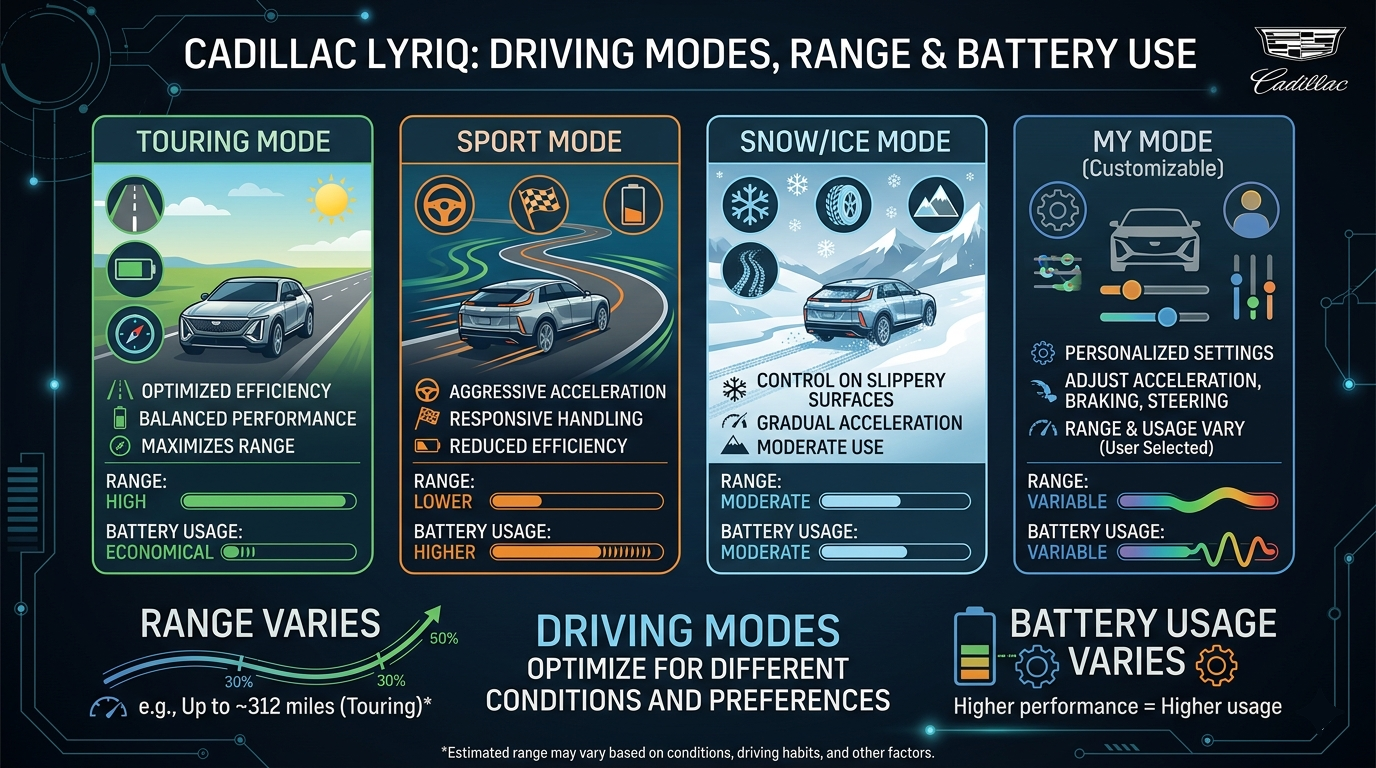
The rise of electric luxury SUVs has changed the way drivers think about performance, efficiency, and everyday comfort. Among the standout models in this category, the Cadillac Lyriq has earned attention for blending premium design with advanced EV technology. Yet one question continues to surface among buyers and enthusiasts alike: do the driving modes in Cadillac Lyriq offer different ranges or battery usages? It’s a practical concern, especially for anyone planning long trips, daily commutes, or simply trying to maximize efficiency from their electric vehicle.
Driving modes in modern EVs are more than just marketing features. They directly influence how the vehicle responds to acceleration, regenerative braking, steering feel, and power distribution. Since these systems affect how energy is consumed, it’s natural to wonder whether selecting a certain mode can extend—or reduce—the available driving range.
Understanding how these modes work in the Cadillac Lyriq can help drivers make smarter choices behind the wheel. It also reveals how subtle adjustments in software can shape the entire driving experience. In this article, we’ll explore the role of driving modes, how they impact battery usage, and whether they truly change the range you can expect from the Cadillac Lyriq.
Table of Contents
ToggleUnderstanding Driving Modes in the Cadillac Lyriq
The Cadillac Lyriq is designed to deliver a personalized driving experience. One of the ways it achieves this is through selectable driving modes. These modes adjust the behavior of the vehicle’s powertrain and other systems to suit different preferences and road conditions.
In general, driving modes in the Lyriq are intended to optimize either efficiency, comfort, or performance. While the exact naming and features may vary depending on trim level and software updates, the core concept remains the same: different modes alter how aggressively the vehicle delivers power and how it manages energy recovery.
For instance, a sport-oriented mode may sharpen throttle response and provide quicker acceleration. This creates a more dynamic feel but can also lead to higher battery consumption if used frequently. On the other hand, an efficiency-focused mode often softens acceleration and prioritizes regenerative braking to recover more energy.
These adjustments do not physically change the battery’s capacity. Instead, they influence how quickly stored energy is used during driving. That distinction is crucial because it means range differences are based on driving behavior encouraged by each mode, rather than a hidden reserve of battery power.
How Battery Usage Changes Across Different Modes
Battery usage in an electric vehicle is closely tied to energy demand. When a driver accelerates rapidly, maintains high speeds, or reduces regenerative braking, the battery drains faster. Driving modes can shape these factors significantly.
In the Cadillac Lyriq, modes emphasizing performance typically draw more power from the battery. This happens because the vehicle allows stronger acceleration and more immediate torque delivery. Since EVs can provide instant power, aggressive settings often tempt drivers to use that capability, which naturally increases consumption.
Efficiency-oriented settings, however, aim to minimize waste. They often encourage smoother acceleration and maximize regenerative braking. By capturing more kinetic energy during deceleration, the vehicle can send electricity back into the battery, slightly extending usable range.
Comfort-focused modes usually strike a balance. They provide a refined and relaxed driving feel without pushing either extreme. Battery usage in these settings often reflects moderate efficiency, making them practical for daily use.
The result is that battery drain patterns differ based on the selected mode, but the extent depends heavily on the driver’s habits. Two people using the same mode may experience different results depending on speed, terrain, climate control usage, and traffic conditions.
Do Driving Modes Actually Affect Range?
The short answer is yes—but not in a dramatic, fixed way. Driving modes can influence range, though the difference is often indirect.
If a driver consistently uses a high-performance setting and accelerates aggressively, the effective range will likely decrease. Conversely, selecting an efficiency-focused mode and driving conservatively can help stretch the battery further.
However, these differences are not always enormous. In real-world conditions, external factors such as weather, road elevation, and HVAC use often have a larger impact on range than the selected driving mode alone.
For example, cold temperatures can reduce battery efficiency more noticeably than switching between comfort and sport settings. Similarly, driving uphill or carrying heavy cargo can consume more energy regardless of mode.
That said, over long distances, even small efficiency gains can add up. A mode that encourages smoother energy use may provide several extra miles of range, which can be valuable when charging opportunities are limited.
So, when asking do the driving modes in Cadillac Lyriq offer different ranges or battery usages?, the most accurate answer is that they do—but mainly through behavioral and software-driven efficiency adjustments rather than direct changes to battery capacity.
The Role of Regenerative Braking
One of the most important contributors to range in the Cadillac Lyriq is regenerative braking. This system converts kinetic energy back into stored electricity when the vehicle slows down.
Driving modes can influence how aggressively regenerative braking is applied. In modes focused on efficiency, the system may recover more energy during deceleration. This can slightly reduce reliance on the friction brakes and improve overall battery performance.
The Lyriq also offers features such as one-pedal driving, which further enhances regeneration. By allowing the driver to slow the vehicle simply by easing off the accelerator, more energy can be captured compared to traditional coasting.
Drivers who combine an efficiency-oriented mode with strong regenerative habits may see better real-world range than those relying on performance settings with minimal regeneration.
This demonstrates that battery usage is not solely about how much power is consumed—it is also about how much energy can be recovered during the drive.
Practical Tips for Maximizing Range in a Cadillac Lyriq
Choosing the right driving mode is only one part of maximizing efficiency. Drivers can take several steps to improve battery performance and extend range.
Smooth acceleration is one of the most effective strategies. Rapid starts consume significant energy, while gradual acceleration conserves power.
Maintaining moderate speeds also helps. High-speed driving increases aerodynamic drag, which can drain the battery faster than city driving.
Using climate controls wisely is another factor. Heating and air conditioning can significantly affect energy usage, especially in extreme weather.
Preconditioning the cabin while the vehicle is plugged in can reduce battery demand once the trip begins.
Tire pressure should also be monitored regularly. Underinflated tires create more rolling resistance, reducing efficiency.
By combining these habits with an appropriate driving mode, Lyriq owners can make the most of every charge.
Why Driving Modes Matter Beyond Efficiency
While range is important, driving modes are about more than battery savings. They enhance the overall ownership experience by allowing drivers to tailor the vehicle’s personality.
A relaxed mode can make commuting smoother and more comfortable. A sportier setting can transform the SUV into a more engaging machine on open roads.
This flexibility is especially valuable in electric vehicles, where software can dramatically alter performance characteristics without mechanical changes.
The Cadillac Lyriq leverages this capability to deliver both luxury and adaptability, ensuring that drivers can prioritize either efficiency or enjoyment depending on the situation.
In that sense, driving modes are less about choosing a fixed range outcome and more about aligning the vehicle’s behavior with the driver’s needs.
Conclusion
The question do the driving modes in Cadillac Lyriq offer different ranges or battery usages? deserves a nuanced answer. Yes, they do influence both range and energy consumption, but primarily by altering vehicle behavior rather than changing the battery itself.
Performance-oriented modes tend to use more energy due to sharper acceleration and increased power delivery. Efficiency-focused settings encourage smoother driving and stronger regenerative braking, which can help extend range.
The overall impact varies depending on driving style, road conditions, weather, and other external factors. In many cases, these influences may outweigh the effect of the chosen mode.
Still, understanding how each mode works allows drivers to make informed decisions and optimize their experience. Whether prioritizing long-distance efficiency or dynamic performance, the Cadillac Lyriq offers flexibility that adapts to different journeys.
Ultimately, driving modes are a valuable tool—not a magic switch. They shape how energy is used and recovered, giving owners greater control over both range and driving enjoyment.
