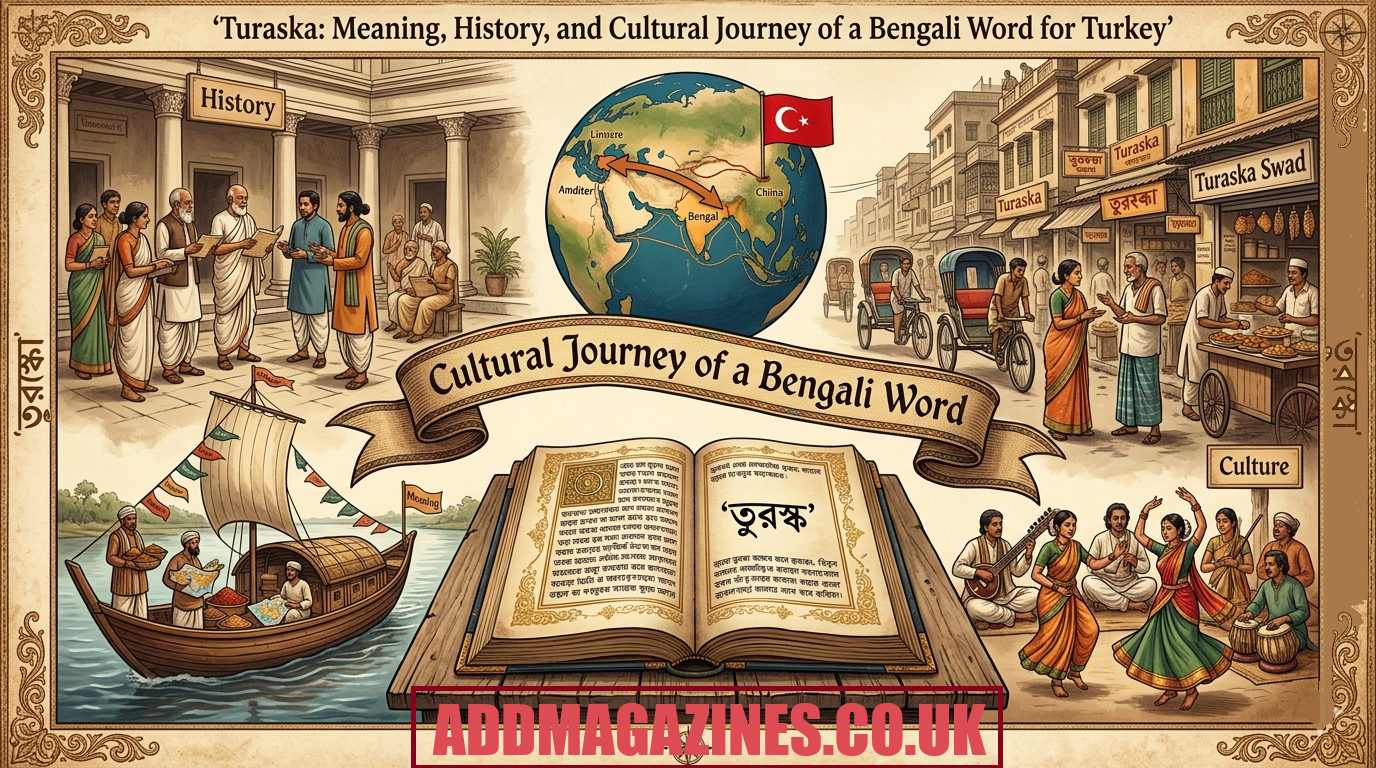
Language is never static—it travels, transforms, and adapts as people and cultures interact over centuries. One such fascinating example from Bengali vocabulary is the word “Turaska”, a term commonly associated with the country we know today as Turkey. While it may look like just a simple transliteration, it actually carries layers of historical, linguistic, and cultural significance that stretch far beyond modern geography.
In everyday Bengali usage, Turaska refers to the Republic of Türkiye, a nation that bridges Asia and Europe both geographically and culturally. Yet, behind this modern reference lies an ancient linguistic journey that begins in classical languages like Sanskrit and passes through centuries of historical interaction between South Asia and Central Asia. To truly understand this term, we need to look not only at what it means today but also at where it came from and how it evolved over time.
The Modern Meaning: Turkey in Bengali Language Context
In contemporary Bengali communication—whether in news media, academic writing, or casual conversation—the term Turaska is widely used to denote the country Turkey. It is a standardized transliteration adapted into Bengali phonetics to represent the English “Turkey” or the official name “Türkiye.”
This usage is especially common in educational materials, geopolitical discussions, and travel-related content. When Bengali speakers refer to international affairs involving Turkey—such as diplomatic relations, cultural exchanges, or tourism—they naturally use this term as part of their native linguistic system.
What makes this interesting is how seamlessly the word integrates into Bengali grammar and pronunciation. Unlike borrowed English words that sometimes remain unchanged, Turaska has been adapted into the natural sound structure of Bengali, making it feel familiar and locally rooted even though it refers to a distant nation.
Linguistic Origins: From Sanskrit to Modern Bengali
To understand the deeper roots of the term, we must travel back in time to ancient South Asian languages. The origin of the word is closely linked to the Sanskrit term “Turuṣka” (तुरुष्क) or “Turushka.”
Historically, this term was used in ancient Indian texts to describe people from Central Asia or Turkic regions. These were communities that interacted with the Indian subcontinent through trade, migration, and occasionally military encounters. Over time, Sanskrit chroniclers used Turuṣka as a general ethnographic label rather than a precise geographical reference.
As languages evolved in the Indian subcontinent, this term gradually entered regional languages, including Bengali. Through phonetic adaptation and linguistic simplification, Turuṣka transformed into variations like Turusk and eventually into the modern Bengali form that resembles Turaska.
This transformation reflects a common linguistic phenomenon: words travel with people, change pronunciation across generations, and eventually settle into new linguistic identities while still preserving traces of their origins.
Historical Context: How Ancient Terms Shape Modern Geography
The connection between ancient ethnographic terms and modern nation-states is not always direct, but it is deeply fascinating. In the case of Turaska, the word’s ancestry reflects how South Asians historically perceived distant regions and peoples.
Centuries ago, the Indian subcontinent had limited direct contact with modern-day Turkey as a nation-state. Instead, interactions were with Turkic groups who migrated or expanded into various regions, including parts of Persia, Central Asia, and later South Asia. These encounters influenced language, culture, architecture, and even political structures in certain historical periods.
Because of these interactions, Sanskrit and later regional languages developed collective terms to refer to these groups. Over time, as global geography became more defined and modern nation-states emerged, these older terms were adapted to align with new political realities.
Thus, the modern Bengali usage of Turaska is not just a translation—it is a linguistic echo of historical encounters that shaped South Asian understanding of the wider world.
Turkey in the Modern World: The Country Behind the Name
Today, the country referred to as Turaska in Bengali is officially known as the Republic of Türkiye. It is a transcontinental nation, meaning it lies in both Asia and Europe, separated by the Bosphorus Strait.
Turkey plays a significant role in global geopolitics due to its strategic location, connecting the East and West. It is known for its rich history that spans ancient civilizations such as the Byzantines and Ottomans, both of which left a lasting cultural and architectural legacy.
Cities like Istanbul stand as living examples of this historical fusion, where mosques, churches, and ancient ruins exist side by side. This unique blend of heritage makes Turkey one of the most culturally diverse and historically significant countries in the world.
For Bengali speakers, the word Turaska serves as a linguistic bridge to this distant but influential civilization, making global geography more relatable within their native language framework.
Cultural Connections Between Bengal and Turkey
Although Bengal and Turkey are geographically distant, cultural and historical interactions have existed in indirect ways over centuries. These connections often came through trade routes, Islamic scholarship, and cultural exchanges during medieval times.
During the period of the Ottoman Empire, trade networks extended across Asia, indirectly linking South Asia with the broader Islamic world, including Anatolia. Scholars, travelers, and merchants carried ideas, art forms, and religious influences across regions.
In modern times, these historical ties have evolved into diplomatic and cultural relationships between Bangladesh and Turkey. Educational exchanges, tourism, and international cooperation have strengthened mutual understanding between the two nations.
Within this context, the Bengali term Turaska is not just a word—it represents a historical thread connecting Bengal to a broader global narrative.
Evolution of Language: How Words Travel Across Time
One of the most fascinating aspects of Turaska is how it demonstrates the evolution of language over centuries. Words are not static objects; they behave like living entities that adapt to cultural shifts, political changes, and social interactions.
The journey from Turuṣka in Sanskrit to its modern Bengali form shows how pronunciation, spelling, and meaning can gradually transform while still retaining a recognizable core. This process is common in many languages around the world, especially in regions with long histories of cultural exchange.
In Bengali, the adaptation of foreign geographical names often follows phonetic patterns that make them easier to pronounce for native speakers. As a result, global names are reshaped into forms that feel natural within the language’s sound system.
This linguistic adaptability is one of the reasons Bengali remains a rich and expressive language, capable of absorbing and reshaping influences from many different cultures.
Symbolic Importance of the Term in Modern Usage
Beyond its literal meaning, the word Turaska also carries symbolic significance. It represents how languages preserve historical memory even when political boundaries and cultural identities change over time.
When Bengali speakers use this term, they are unconsciously engaging with a linguistic tradition that spans thousands of years. It reflects how ancient perceptions of the world continue to exist within modern vocabulary.
This symbolic continuity highlights the importance of language as a cultural archive. Every word carries traces of history, and Turaska is a perfect example of how a single term can connect ancient civilizations with contemporary global geography.
Conclusion: A Word That Connects Past and Present
The journey of Turaska from its ancient Sanskrit roots to its modern Bengali usage is a powerful reminder of how language evolves alongside human history. What began as a broad ethnographic term for Central Asian peoples gradually transformed into a standardized name for a modern nation-state.
Today, it stands as the Bengali representation of Turkey, a country that itself sits at the crossroads of continents and civilizations. In this way, the word mirrors the very identity of the country it describes—bridging East and West, past and present.
Understanding such terms enriches our appreciation of language not just as a communication tool, but as a living record of human civilization. Every time the word Turaska is used, it quietly carries centuries of history, cultural exchange, and linguistic transformation within it.
In the end, it is more than just a name—it is a story written across time, preserved in sound, and spoken in everyday life.
For More Updates: