
About Datrihelminen Life often refers to tapeworms, a group of parasitic flatworms known for their complex lifecycles and presence in the intestines of various hosts. These cestodes exhibit a unique biological structure designed to secure themselves inside the host’s digestive tract and reproduce effectively. Studying their life helps us understand infection risks, transmission, and treatment options.
Fish tapeworms, particularly Diphyllobothrium latum, are prominent examples of datrihelminen that infect humans when consuming contaminated or undercooked fish. This article explores the detailed anatomy, lifecycle, and medical implications of these parasites.
Understanding the basic structure and lifecycle of datrihelminen is essential for better clinical recognition and public health interventions. This knowledge also explains why tapeworm infections are common in certain geographical areas and food habits.
Basic Structure of Datrihelminen (Tapeworms)
All tapeworms share a fundamental body design that enables their parasitic lifestyle. The most anterior part is the scolex, often referred to as the head, equipped with suckers and sometimes hooks. These attachments firmly anchor the tapeworm to the intestinal wall.
Directly beneath the scolex is the neck, also known as the generative zone. The neck produces individual segments called proglottids that form a long chain known as the strobila or body. This structure allows continuous reproduction and growth.
Proglottids are hermaphroditic, containing both male and female reproductive organs, enabling self-fertilization. As segments mature toward the tail end, they become fully loaded with fertilized eggs ready to exit the host’s body and continue the life cycle.
The Lifecycle of Fish Tapeworms
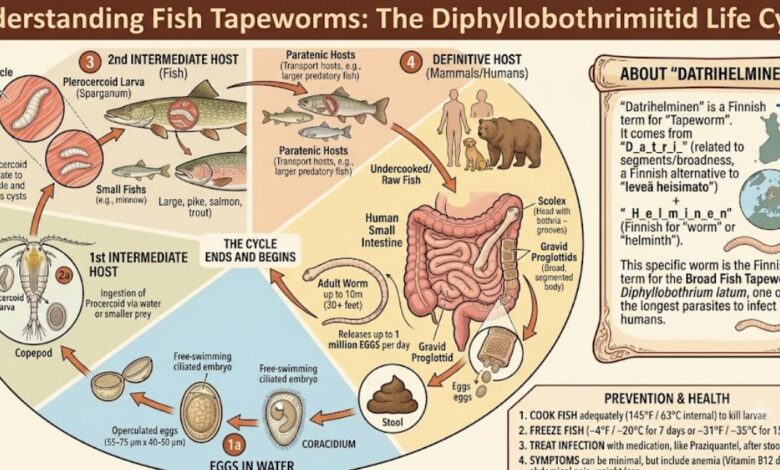
The lifecycle of datrihelminen, particularly the fish tapeworm, is complex and involves multiple hosts. The adult tapeworm resides in the definitive host’s small intestine, where it reproduces sexually and sheds eggs in the feces.
Once expelled, eggs hatch in freshwater environments releasing larvae that are consumed by microscopic aquatic organisms called cyclops, the intermediate hosts. These invertebrates harbor the developing larval stage, which then infects fish when they eat the cyclops.
The parasite grows inside fish tissues and becomes infective to humans or other definitive hosts once the fish is consumed raw or undercooked. The fish tapeworm then attaches to the small intestine and matures over weeks, completing the cycle.
Definitive and Intermediate Hosts
The definitive host is where the adult tapeworm lives and reproduces, typically humans or other fish-eating mammals. Here, egg-laying occurs, facilitating parasite transmission.
The intermediate host ingests the eggs, allowing the larvae to develop inside its tissues. For the fish tapeworm, these hosts include tiny aquatic animals like cyclops and freshwater fish that accumulate the larvae.
Transmission to humans occurs primarily through the consumption of raw or inadequately cooked freshwater fish. Without the definitive host ingesting the infected fish tissue, the tapeworm lifecycle remains incomplete.
Transmission and Risk Factors
Understanding transmission is key to preventing datrihelminen infections. The fish tapeworm spreads when humans eat contaminated freshwater fish that harbor larval parasites inside muscle tissues.
Risk factors include poor sanitation allowing eggs to enter freshwater bodies, cultural preferences for raw or lightly cooked fish, and access to untreated freshwater sources where intermediate hosts thrive. Regions with these characteristics see higher infection rates.
Proper cooking of fish to safe temperatures destroys larvae. Additionally, improving sanitation and water quality can interrupt the lifecycle by preventing eggs from reaching intermediate hosts.
Common Hosts and Geographical Distribution
Diphyllobothrium latum mainly infects humans, bears, dogs, and other fish-eating animals. The geographical range corresponds to freshwater environments supporting suitable fish and intermediate hosts, commonly found in parts of Europe, North America, and Asia.
The parasite prefers cool and temperate freshwater lakes and rivers. Popular fish species involved include pike, perch, salmon, and trout, which can carry infectious larvae within their flesh.
Because infection depends largely on diet and sanitation, communities eating raw freshwater fish and those with inadequate waste management are at greater risk.
Symptoms and Clinical Presentation
Many individuals infected with fish tapeworms are asymptomatic and unaware they carry the parasite. Occasionally, symptoms arise primarily due to mechanical irritation or nutritional competition by the worms.
Patients might experience abdominal discomfort, mild diarrhea, weight loss, or fatigue. In rare cases, vitamin B12 deficiency may occur due to the parasite consuming it, leading to anemia and neurological symptoms.
Segments of the tapeworm (proglottids) can sometimes be seen in stool or passed through the rectum, which often prompts medical attention and diagnosis.
Signs to Watch For
Painless passage of tapeworm segments in stool is one of the most specific indicators of infection. Examination of stool samples under microscopy may reveal eggs or larvae.
Other symptoms are often vague and can include nausea, abdominal pain, or unexplained weight loss. These symptoms require clinical correlation with risk factors like recent consumption of raw freshwater fish.
Early detection is crucial to prevent complications such as severe anemia or intestinal obstruction in rare severe infections.
Diagnosis of Fish Tapeworm Infection
Diagnosing datrihelminen infections relies primarily on stool examination for eggs or proglottids. Laboratory technicians look for characteristic eggs with operculums or segments containing reproductive organs.
A fecal OVA (ova and parasite) test is the standard diagnostic technique. Sometimes, patients may provide segments that can be visually identified and confirmed by microscopic examination.
Diagnosis may also involve patient history, especially recent consumption of raw or undercooked fish from endemic areas, providing critical epidemiological clues.
Additional Diagnostic Methods
In some cases, blood tests may detect anemia or vitamin deficiencies related to infection, supporting the diagnosis. Imaging studies are rarely required but might be indicated for complicated cases.
Serological tests exist but are less commonly used due to the effectiveness of stool analysis and direct visualization of the parasite parts.
Prompt diagnosis ensures timely treatment to fully eradicate the tapeworm and prevent ongoing transmission.
Treatment and Prevention Strategies
The primary treatment for fish tapeworm infection is the antiparasitic drug praziquantel. This medication disrupts the tapeworm’s cell membranes, killing the worm rapidly.
Usually, a single dose is sufficient to clear the infection, followed by stool tests to confirm eradication. Supportive care includes correcting nutritional deficiencies if present.
Prevention focuses on proper cooking of freshwater fish to temperatures that kill larvae and improving sanitation to reduce environmental contamination by eggs.
Public Health and Personal Measures
- Avoid consuming raw or undercooked freshwater fish from endemic areas.
- Improve access to clean water and sanitary waste disposal to prevent eggs contaminating water bodies.
- Educate communities about the lifecycle and risks associated with datrihelminen.
Summary of Key Concepts on Datrihelminen
Datrihelminen, especially the fish tapeworm Diphyllobothrium latum, are notable parasites with a distinctive anatomy including a scolex and segmented body for reproduction. They depend on multiple hosts to complete their lifecycle.
Infections occur when humans eat raw or undercooked freshwater fish containing larval cysts. Eggs must pass from humans to water to complete the cycle, emphasizing the importance of sanitation.
Symptoms range from no discomfort to vitamin B12 deficiency and are diagnosed mainly through stool testing. Treatment with praziquantel is effective and prevention relies on proper fish preparation and sanitation improvements.
FAQs
What is datrihelminen life?
It refers to the lifecycle, structure, and biology of tapeworms, specifically fish tapeworms that infect hosts through contaminated fish consumption.
How do people become infected with fish tapeworms?
By eating raw or undercooked freshwater fish containing larvae that develop into adult worms inside the human intestine.
What are the common symptoms of a fish tapeworm infection?
Often no symptoms, but may include abdominal pain, diarrhea, fatigue, or passage of worm segments in stool.
How is fish tapeworm infection diagnosed?
Through stool examination for eggs or proglottids, often supported by relevant patient history of fish consumption.
What is the best treatment for datrihelminen infections?
The antiparasitic drug praziquantel effectively kills tapeworms, usually in a single dose.
Conclusion
Understanding about datrihelminen life provides crucial insight into the biology, transmission, and management of fish tapeworm infections. Their unique structure and dependency on multiple hosts underscore why human behaviors like diet and sanitation critically influence infection rates. Early recognition of signs and symptoms, prompt diagnosis, and effective treatment can prevent complications and limit spread. Public education and proper food safety remain cornerstone strategies to reduce this parasitic threat globally.


