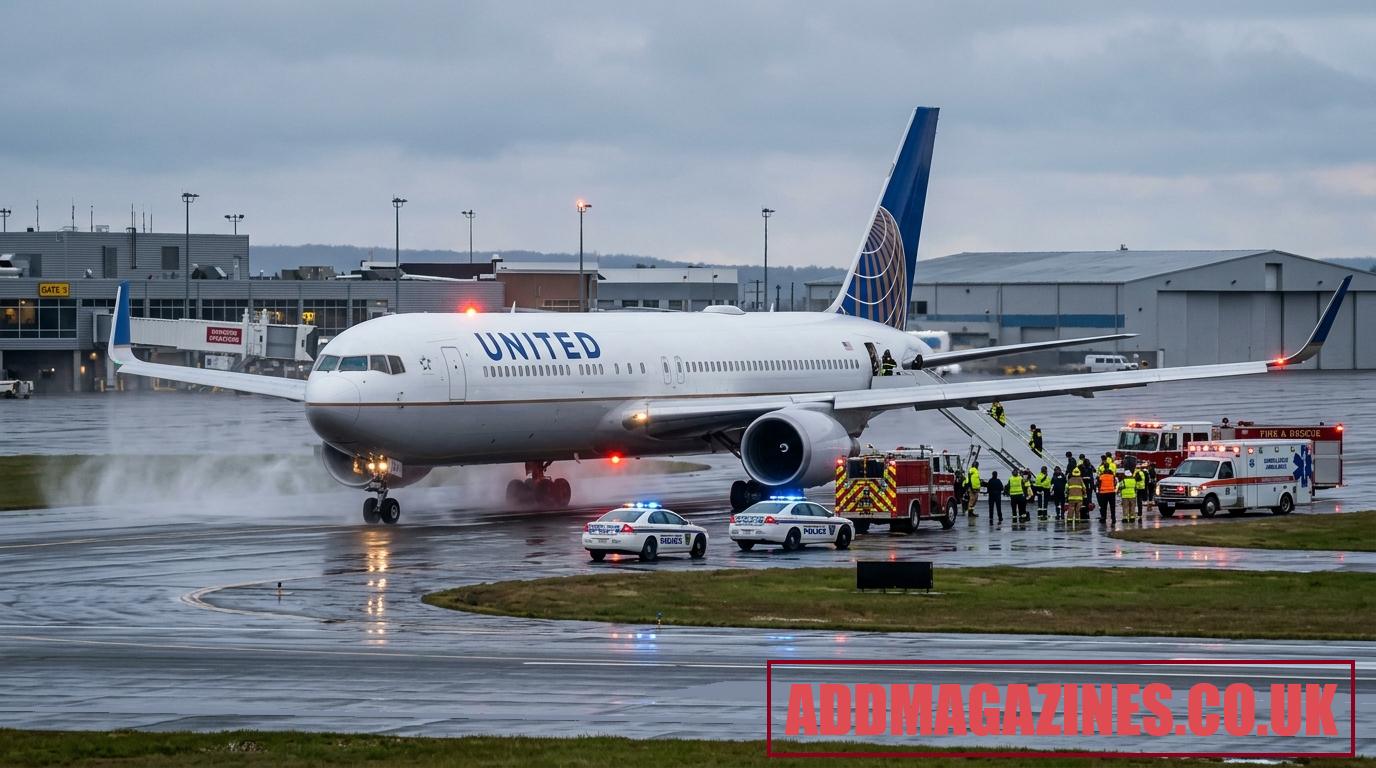
A Transatlantic Journey That Took an Unexpected Turn
The event involving United Airlines Flight UA109 quickly drew attention in aviation circles due to its unusual but professionally handled diversion during a routine transatlantic service. The flight was operating from Munich International Airport (MUC) to Washington Dulles International Airport (IAD) on October 30, 2025, when an in-flight medical situation required an unscheduled landing. Roughly 90 minutes after departure, while the aircraft was cruising over the Atlantic Ocean, a cabin crew member began experiencing significant discomfort caused by a painful blister. Although this might sound minor in a normal context, the condition escalated into a serious operational concern because it impaired the crew member’s ability to safely perform required safety duties onboard a long-haul flight. In aviation, even seemingly small medical issues can become critical when they affect crew readiness, especially on intercontinental routes where staffing requirements are strictly regulated.
This particular situation highlights how airline operations are built around redundancy, safety margins, and strict compliance with international aviation standards. Long-haul flights are not only about transporting passengers from one destination to another but also ensuring that every regulatory requirement is continuously met throughout the journey. Once the issue became evident, the cockpit crew evaluated the situation in coordination with the airline’s operations center. Given the location over the Atlantic and the importance of maintaining a fully functional cabin crew complement, the decision was made to alter course and proceed toward the nearest suitable airport. This marked the beginning of what later became widely discussed as the united flight ua109 diversion, a controlled and safety-driven response rather than a reaction to mechanical failure or external threat.
Decision-Making in the Air: Why the Diversion Was Necessary
The decision to divert a commercial aircraft mid-flight is never taken lightly, and in this case, it was driven by a combination of medical urgency and strict operational requirements. Approximately 90 minutes into the journey, the affected cabin crew member’s condition worsened enough to raise concerns about their ability to continue performing essential safety-related responsibilities. On long-haul international flights, cabin crew are required not only for passenger service but also for emergency preparedness, including evacuation procedures, safety demonstrations, and coordination during critical incidents. Regulations governing extended-range twin-engine operations (ETOPS) and airline crew minimums mean that even the loss of one key crew member can affect the legality and safety of continuing the flight.
The captain, in consultation with medical support on the ground and airline operations, assessed multiple options before making the final call. Continuing to Washington with a reduced or impaired crew was not considered safe under aviation regulations, especially given the remaining flight time over remote oceanic airspace. Instead, the aircraft executed a controlled U-turn over the Atlantic and set course toward Dublin Airport (DUB), one of the nearest major diversion points with adequate medical facilities and operational infrastructure. This choice reflects standard industry practice, where safety and regulatory compliance always override schedule considerations. The situation also demonstrates how well-trained flight crews and airline systems work together in real time to ensure that passengers remain safe, even when unexpected health issues arise at cruising altitude.
Landing in Dublin: A Smooth Execution Under Pressure
When the aircraft descended toward Dublin Airport, the operation remained calm and orderly, despite the unexpected nature of the diversion. The crew maintained communication with passengers, explaining that the landing was precautionary and related to a medical issue onboard. Such transparency is important in maintaining passenger confidence during unscheduled changes in flight plans. The aircraft landed safely at Dublin Airport without any technical complications, and emergency medical teams were already prepared on the ground to assist the affected crew member upon arrival.
Once on the ground, the cabin crew member received immediate medical attention, and the situation was stabilized. Although the issue was described as a painful blister, its impact on mobility and duty performance was enough to justify the diversion under aviation safety rules. Meanwhile, ground teams in Dublin coordinated with United Airlines to assess the aircraft’s readiness for continuation. After ensuring that the crew composition was restored to meet regulatory requirements and confirming that there were no additional operational concerns, preparations began to resume the journey to Washington Dulles. This phase of the operation reflects the efficiency of airport emergency response systems and the importance of having diversion airports strategically positioned along transatlantic routes.
For passengers, the experience resulted in a delay of approximately two hours, but the overall journey remained largely unaffected beyond the unexpected stop. Communication from the airline emphasized that the decision prioritized safety above all else, reinforcing standard aviation principles that govern such events. The handling of the united flight ua109 diversion is often referenced in aviation discussions as an example of how even minor medical issues can trigger significant but well-managed operational changes when crew safety is involved.
Continuing the Journey: Recovery and Resumption of Flight
After the necessary medical response and operational checks were completed in Dublin, the aircraft was cleared to continue its flight to Washington Dulles. The turnaround process involved coordination between ground staff, flight operations, and regulatory compliance teams to ensure that all requirements were fully satisfied before departure. Once the crew was confirmed fit to continue and staffing levels were restored to operational standards, the aircraft resumed its transatlantic journey.
The remainder of the flight proceeded without incident, and the aircraft eventually arrived in Washington with only a minor delay compared to the original schedule. From an operational standpoint, the disruption was minimal, especially considering the nature of the event that triggered it. Passengers were able to complete their journey safely, and no further complications were reported. The airline’s handling of the situation demonstrated the effectiveness of contingency planning in long-haul aviation, where multiple layers of safety protocols are designed to address both medical and technical emergencies without compromising passenger welfare.
Events like this also highlight the importance of ETOPS planning, which governs how twin-engine aircraft operate over long distances from diversion airports. The successful execution of the diversion and continuation of the flight underscores how modern aviation systems are built to handle unexpected challenges with precision and control. While passengers may have experienced inconvenience, the broader outcome reinforced the reliability of aviation safety systems and the professionalism of flight crews operating under pressure.
Lessons from the Incident: Safety, Training, and Aviation Standards
The broader significance of this event extends beyond a single flight diversion. It serves as a reminder of how aviation safety is fundamentally built on preparedness, regulation, and rapid decision-making. Cabin crew members are essential to the safe operation of any commercial flight, and their ability to perform duties without impairment is a legal requirement, not just an operational preference. In this case, a seemingly minor medical issue was treated with the seriousness it deserved, ensuring that no risks were taken with passenger safety or regulatory compliance.
The united flight ua109 diversion also illustrates the strength of international aviation coordination. From the cockpit crew’s immediate assessment to ground-based medical consultation and airport emergency response, every stage of the process worked in synchronization. This level of coordination is the result of continuous training, simulation exercises, and strict adherence to global aviation standards. It is precisely this framework that allows airlines to manage unexpected events without escalating them into emergencies.
In the broader context of air travel safety, incidents like this reinforce public confidence in aviation systems. While diversions can be inconvenient, they are ultimately a sign that safety protocols are functioning as intended. The aviation industry consistently prioritizes human life and operational integrity over scheduling or cost considerations. This philosophy ensures that even when disruptions occur, they are managed in a controlled and predictable manner, minimizing risk and ensuring safe outcomes for everyone involved.
For More Updates: